How Much Should an App Cost?
The question behind the question is usually whether you are being taken advantage of. Here is how to judge a quote for an app when you are not technical, without needing anybody's price list.
People rarely ask this question because they want a number. They ask it because they suspect they are about to be taken advantage of and have no way of telling.
That is a reasonable suspicion. You are being asked to buy something you cannot inspect, from somebody whose expertise you cannot assess, using words you have no reason to know. The question underneath “how much should an app cost” is usually “how would I know if this was a bad deal”, and that one does have an answer.
“An app” is four different things
The word covers a range wide enough that any single figure is meaningless.
A form on a website that emails you when somebody fills it in is a day or two of work. A website that pulls live availability out of your booking system is weeks. A system that runs a real operational process — jobs, engineers, stock, invoices — is months. A phone app in the App Store and the Play Store is all of the above plus two platforms, two review processes and an ongoing obligation to keep up with operating system releases.
A surprising number of businesses that ask for a phone app actually need a website that works properly on a phone. It does most of what they want, it costs materially less, and nobody has to download anything. It is worth asking any supplier why they think you need the app version, and listening to whether the reason is about your customers or about their skills.
Do the arithmetic yourself
Every quote is people, multiplied by weeks, multiplied by a rate. Ask for those three numbers.
Then multiply them and see whether they give you the total. If they do, you now understand the quote and can argue about the right thing, which is scope. If they do not, ask what the difference is. There may be a good answer. There may not be one.
A supplier who declines to break a quote down that way is making a choice about how much you are allowed to understand, and that choice will not improve once you have signed.
Compare like with like
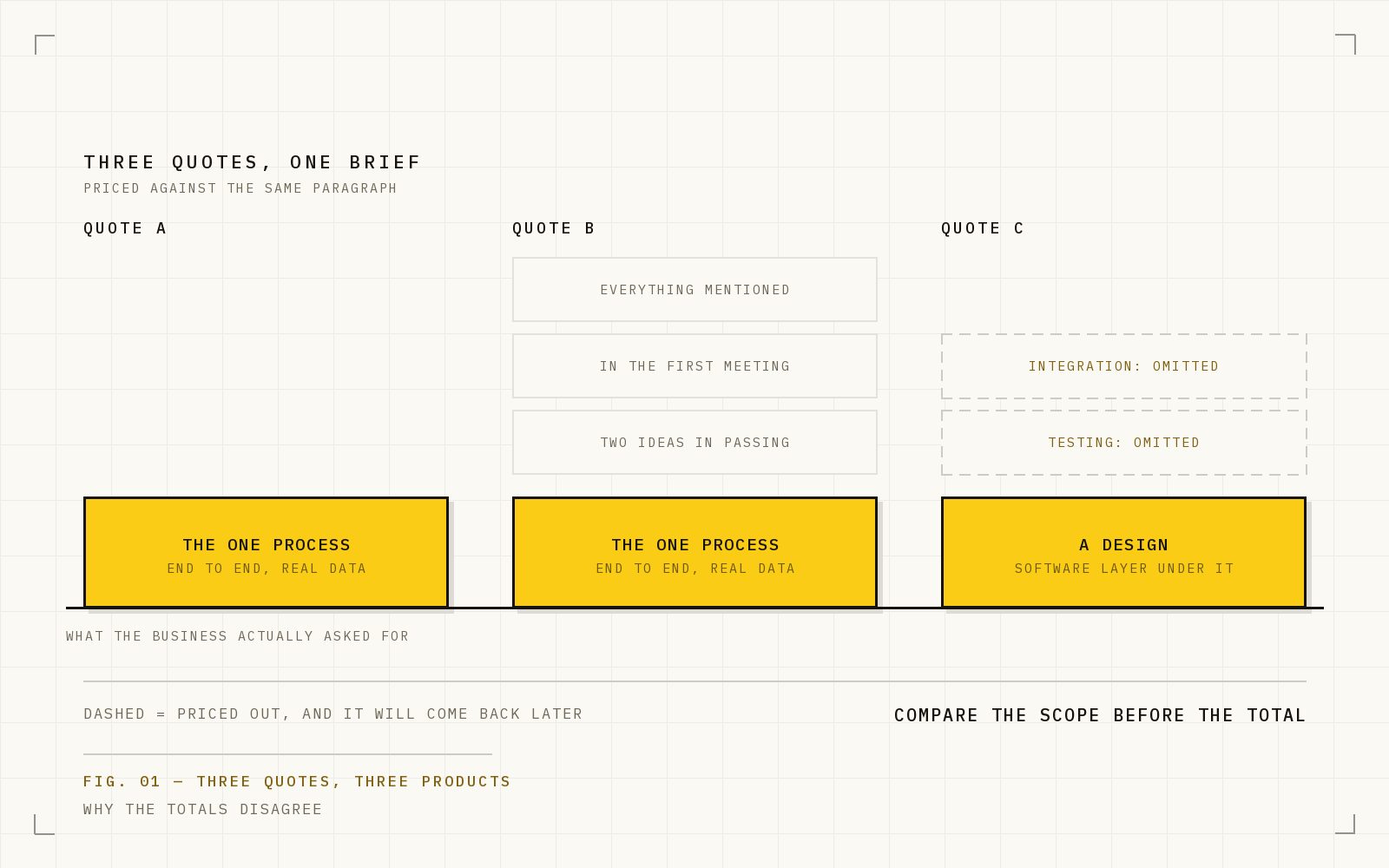
Three quotes for “an app” are usually three quotes for three different products.
Write down, in a paragraph, the single process the first version has to handle from start to finish. Send that same paragraph to everybody. Ask each of them to price precisely that and to list separately anything they think it needs on top.
The list they add is the most informative part of the response. It tells you what they noticed about your business that you did not put in the paragraph. One supplier will spot that the process involves a payment and ask who takes the risk on refunds. Another will not mention it. That difference is worth more than the difference in price.
The five questions that predict how it goes
None of these are about money, and the answers tell you more than the total does.
Who is actually writing the code, and how long have they been doing it? Sold by somebody senior, built by somebody junior is the most expensive pattern in this industry, and it is invisible from outside. You are allowed to ask to meet them.
Who reviews their work? “Nobody” is a real answer that people give.
Do I own the code, the accounts, the domain and the data? Get this in writing, at the start, when it is uncontroversial. It becomes very controversial later.
When will I see something working, with real data in it? If the first working thing appears at the end, you have no way to steer and no way to stop while there is still budget left.
What happens if we part company? A supplier confident in their work will answer this cheerfully. Somebody planning to make you dependent will not.
What a low price is usually buying
Cheap because the scope is honestly smaller is often exactly right, and I have told people to take that deal.
Cheap for these reasons is not:
- Integration has been left out and will come back as a change request at a rate nobody has agreed.
- The estimate covers building it and not the fortnight of fixing that follows real users touching it. That fortnight is not optional; it is just missing from the paperwork.
- The work is going offshore to a team you will never speak to, with no allowance for the time it takes to explain a business over email.
- The margin is coming from a support contract you have not been shown.
What an expensive quote might legitimately be buying
Being expensive is not the same as being dishonest. A higher number can be paying for somebody senior doing the work rather than supervising it, for proper handling of payments or regulated data, for the integration work that the cheap quote quietly omitted, or for testing that means the thing does not fall over in your busiest week.
A high quote is only a problem when nobody has explained which of those you are buying.
If you would rather not judge it alone
Reading a proposal and the systems behind it, and saying plainly whether it will do what you need, is work I do. Plenty of those end with me saying the supplier is fine and you should go ahead.
If the conclusion is that the thing genuinely needs building and there is nobody senior to build it, that is the other one. The article on what an MVP actually costs goes further into what moves the number once you have decided to go ahead.