What an MVP Actually Costs
Why quotes for the same MVP come back a factor of five apart, what you are actually paying for, and how to work out the number yourself instead of taking somebody's word for it.
You have a quote in front of you. Possibly two, and they are a factor of five apart for what you described as the same thing. Nobody in your business can tell you which one is right, and the people who wrote them both have an interest in you saying yes.
This is the most common position I get called into, and the honest answer to “what should this cost” is that nobody can tell you from the outside. What they can tell you is how the number is built, which is enough to work it out yourself.
The arithmetic is not complicated
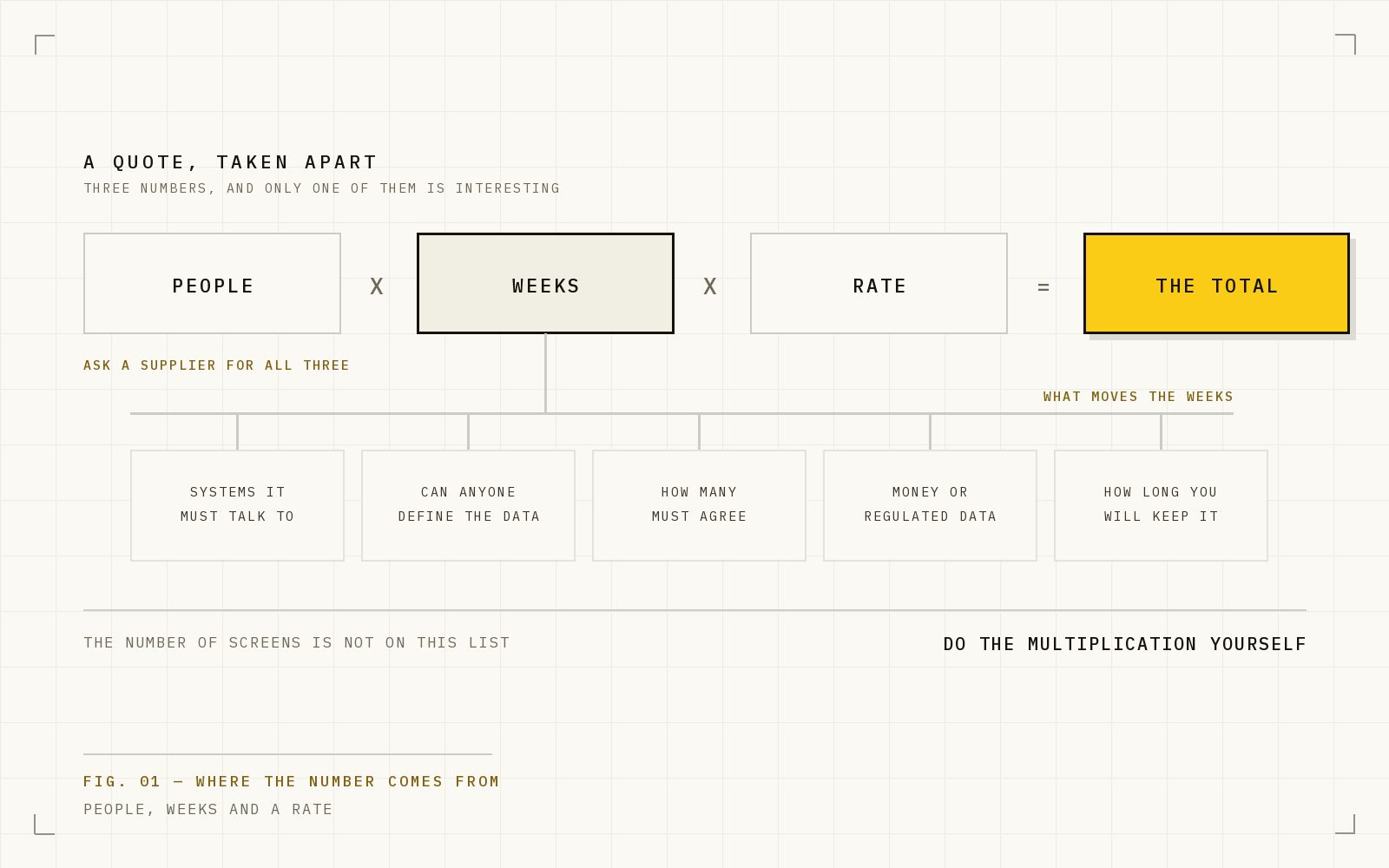
A software quote is people, multiplied by time, multiplied by a rate. That is the whole thing. Everything else in the document is describing one of those three.
So ask for all three. How many people will be on it, and what is each of them doing? For how many weeks? At what rate? Any supplier can answer that in one email. A supplier who will not answer it is telling you something, and it is worth noticing what.
Once you have the three numbers you can do the multiplication, and you will usually find one of two things. Either the total makes sense and you are arguing about scope rather than price, or it does not reconcile, which means there is padding, or there is work in there that nobody has explained to you.
Why the same brief gets wildly different numbers
They are almost never quoting the same thing.
One supplier has read your brief and priced a working version of one process. Another has priced everything that came up in the meeting, including the two ideas you mentioned in passing. A third has priced a nice design with a thin layer of software underneath it, because that is what they are good at, and the hard part is quietly missing.
The fastest way to make quotes comparable is to write down the one process the first version has to do, end to end, and ask all three to price precisely that. If one of them says that is not enough to be useful, listen carefully to why. They might be right, and the reason will tell you what they understand about your business.
What actually moves the number
Five things, and the number of screens is not one of them.
How much it has to talk to. Something that stands on its own is straightforward. Something that has to stay in step with your accounts package, your booking system and a supplier’s feed is a different job. Most of the work lives in the joins between systems, and the joins are the part quotes routinely underestimate.
Whether anybody can define the data. If nobody in the business can say what a job is without adding “well, it depends”, that gap has to be closed before anything can be built around it. That is real work. It is also the work that saves the most money, and it is the first thing cut from a cheap quote.
How many people have to agree. One owner deciding takes an afternoon. Four departments with a view takes as many weeks as it takes, and no amount of engineering speeds that up. If your project has a steering group, that belongs in the estimate.
Whether it touches money or regulated data. Payments, health data and anything sitting under FCA rules add work to the build and considerably more to the testing. None of it is optional, and none of it can be bolted on at the end.
How long you intend to keep it. Something you will run for five years is built differently from something you expect to replace next year. Both are legitimate choices. Deciding which one you are paying for changes the number, and most quotes never ask.
What a cheap quote usually means
Cheaper because the scope is genuinely smaller is a good outcome, and it is often the right answer.
Cheaper for any of these reasons usually is not:
- The integration work has been left out and will arrive later as a change request, at a rate nobody agreed in advance.
- A junior is doing the work with nobody senior reviewing it. This is the most expensive pattern in the industry and it is invisible from the outside. Ask who is writing the code, how long they have been doing it, and who checks it.
- The estimate is for building it and not for the two weeks of fixing that follows first contact with real users. That fortnight always happens. If it is not in the quote it is still going to be in your year.
- The price is low because the supplier expects to make it back on a support contract you have not seen yet.
The costs that never appear in the quote
Your own people’s time is the big one. Somebody in your business has to answer questions, test things and make decisions, and if that person is you, it comes out of the time you were spending running the company. Half a day a week is a realistic minimum for anything meaningful, and it is worth deciding in advance who that is.
Then there is what it costs to run once it exists: hosting, licences, the occasional bit of maintenance when something upstream changes. It is usually modest, and it is usually a surprise, because nobody mentioned it.
What you should be getting, whatever the number is
Independent of price, these are worth insisting on, and they cost a supplier nothing to agree to if they were planning to behave well anyway.
- You own the code, the accounts, the domain and the data, in writing, from the start.
- A named person who is actually writing the code, and a way to talk to them.
- A working thing in front of a real user early, rather than a demo at the end.
- Something written down that another developer could pick up if the relationship ended tomorrow.
A supplier who declines any of those is telling you something about how the relationship will run, and it is worth knowing that before the price is agreed.
Working it out with somebody
Reading a quote like this is part of a bigger job: going and finding out what is actually wrong, then writing down what to do about it. That is working out what to do, and the plan it produces is yours to build with anyone.
If the answer is that the thing does need building, I build first versions, and the same five things above are what set the length of the work. I do not put numbers on a page, because a number that knows nothing about your business is worth about as much as the ones you are currently trying to compare.