Peter Thiel Just Bet $2 Billion on AI Cow Collars. They're Coming to the UK.
Halter raised $220m at a $2B valuation backed by Founders Fund. They're launching in the UK in 2026. Here's what it means for British farming and the food businesses that depend on it.
Peter Thiel Just Bet $2 Billion on AI Cow Collars. They’re Coming to the UK.
Peter Thiel’s Founders Fund just led a $220 million raise for Halter, a New Zealand startup that puts AI-powered GPS collars on cows. The company is now valued at $2 billion. It is confirmed for launch in the UK later this year.
Founders Fund first backed Halter at Series A in 2017. That’s nine years of conviction before this headline. The same investors who funded SpaceX, Stripe and Palantir have been quietly betting on a “cowgorithm” for nearly a decade.
This is not hype. This is the signal.
What Halter actually does
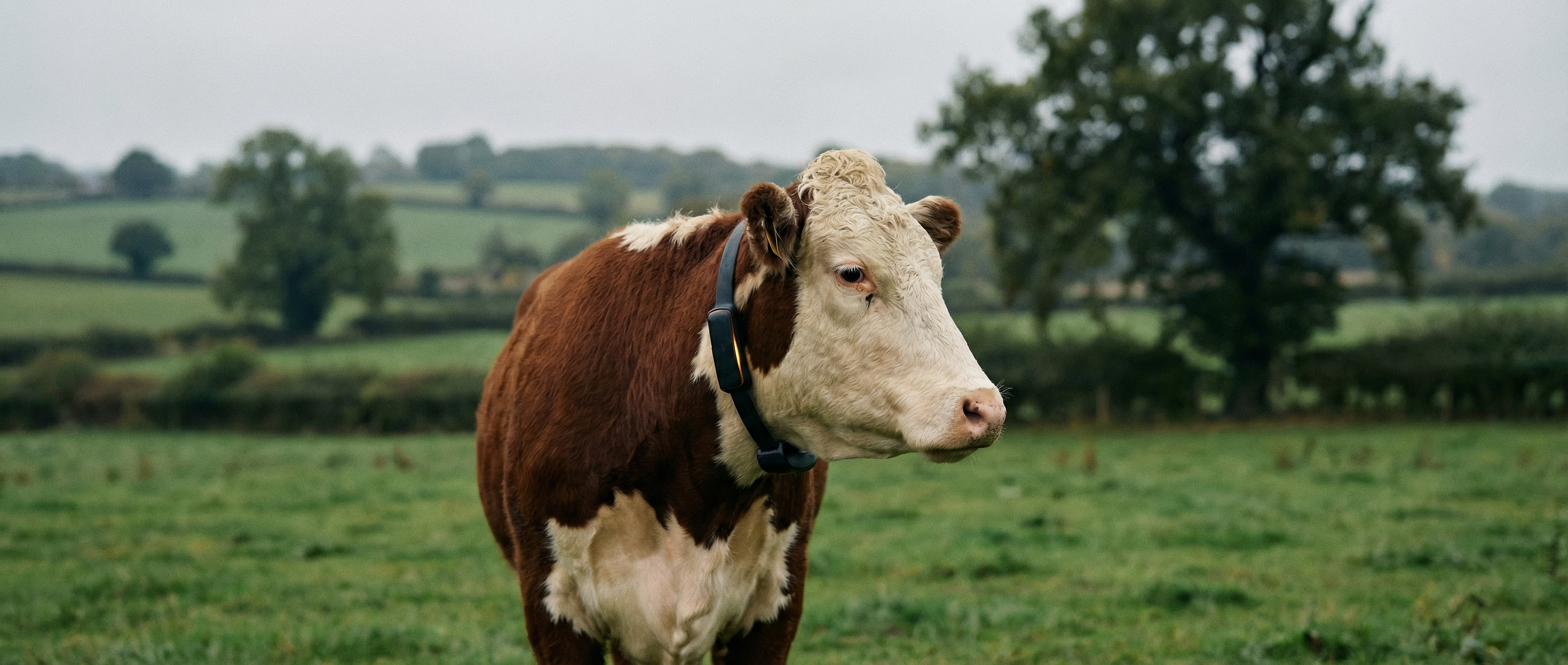
The collar is solar-powered and GPS-enabled. It delivers audio cues and gentle vibrations to contain and move cattle within software-defined boundaries: virtual fencing. A farmer can redraw those fence lines from a smartphone, shifting the herd across pastureland without wire, posts, or riding out.
Halter has sold one million collars. It serves over 2,000 ranchers across New Zealand, Australia and the United States. Since launching in the US in 2024, American ranchers have built 60,000 miles of virtual fencing, up from 11,000 miles as recently as late 2025. That is exceptional adoption velocity for a piece of deep tech in one of the most conservative industries on earth.
Amin Mirzadegan, Partner at Founders Fund, put his finger on exactly why that matters:
“Halter is changing that by bringing software, sensors, and AI directly into livestock operations in a way that ranchers actually adopt.”
The historic failure mode for agri-tech is elegant products that farmers don’t use. Mirzadegan is naming adoption as the thing Halter has actually cracked.
UK and Irish farmers are next. The official Series E announcement confirmed expansion into Ireland and the UK later in 2026.
What’s already on UK farms
Halter is arriving into a sector that is already moving, quietly, without much fanfare.
There’s a camera mounted above the exit of a milking parlour in Somerset. It watches each cow as she walks through. Deep learning assesses her gait, her posture, her weight distribution. If something’s off, the system flags it that day, not next week.
Early lameness detection like this saves around £300 per cow in treatment costs, lost milk yield and premature culling. That figure comes from Agri-EPI’s South West Dairy Development Centre, published by The Grocer in May 2025.
A camera over a door and some pattern recognition. £300 a cow.
CattleEye, founded in Belfast, uses standard low-cost security cameras and computer vision to identify individual cows by their unique markings, assess locomotion continuously, and flag welfare issues before the farmer would. They launched in the UK through GEA Farm Technologies at DairyTech 2024.
Herdwatch is a cloud-based livestock management platform used on over 18,000 farms across the UK and Ireland. Herd records, breeding data, treatments, compliance: all managed from a smartphone, with an AI layer for anomaly detection. It starts at around £20 a month.
Small Robot Company, a Shropshire-based agri-robot startup that pioneered per-plant AI weeding, went into liquidation in February 2024 after a funding round fell through. A reminder that the sector is still early and not every bet will land.
This is not vaporware. These are live products, on working farms, delivering measurable outcomes.
The adoption problem everyone’s actually facing
Only 16% of UK businesses currently use at least one AI technology. That’s from DSIT’s AI Adoption Research, published in February 2026. One in six.
Agriculture sits at the lower end of that curve. But the shape of the problem is identical across every sector: cost, connectivity, skills, trust.
Farmers aren’t uniquely resistant to change. They’re facing the same barriers as every SME owner who’s looked at AI tools and thought: I can’t figure out if this will actually work for us, the upfront cost is uncomfortable, and I don’t have time to find out the hard way.
The mud is different. The problem is the same.
The connectivity problem is real
An NFU survey published in July 2025 found that only 33% of UK farmers had fibre broadband speeds. Nearly one in ten had no 4G or 5G access at all. Most AI and IoT systems require a stable internet connection. On a farm in mid-Wales or rural Northumberland, that isn’t a given.
This isn’t a reason to dismiss the technology, and it is becoming less of a barrier every year. Starlink and other low-earth-orbit satellite services now provide fast, reliable broadband to farms that would have been written off as unconnectable five years ago. A hill farm in mid-Wales or the Scottish Highlands can now get 100+ Mbps. The connectivity problem is real today; it is not a permanent structural barrier. Before ruling out any technology on connectivity grounds, check what satellite options are available. The picture has changed.
Why food businesses need to pay attention
This isn’t just a story for farmers.
Retailers and food brands are starting to ask harder questions about where food comes from. Not just “is it Red Tractor accredited?” but: what does the welfare data actually show? Can you prove it? Can you share it in real time?
AI-equipped farms can answer those questions. Farms without the data infrastructure increasingly can’t.
Treefera, a UK AI platform, aggregates farm data and converts it into verified carbon credits, sold to companies like Nestlé and Unilever. The EU Deforestation Regulation is adding legal teeth to traceability requirements for businesses trading across EU borders. A Halter-equipped farm generates continuous location and health data on every animal: a provenance layer that premium retailers are beginning to demand.
If you’re a food brand, a supplier, or a retailer sourcing from UK farms, your supply chain is about to get significantly more transparent. The question is whether you’re ahead of that or behind it.
The money exists
The government funding is significant, and it isn’t all aimed at large agribusinesses.
- ADOPT Fund (Defra + Innovate UK): £20.6m for farmer-led trials of new technology. Grants of £50k–£100k. Launched April 2025.
- FETF 2026 (Farming Equipment and Technology Fund): £50m in capital grants for precision tools, monitoring systems and digital technology.
- BridgeAI: £100m for AI innovation across four sectors, including agriculture, with a 14-week accelerator specifically for UK companies developing AI for agri-food.
The SFI26 scheme specifically designed its June window for small farms of three to fifty hectares and rewards data-rich delivery. Precision technology becomes the most efficient route to qualifying for payments.
The funding infrastructure is there. The adoption isn’t. That gap is where the opportunity sits.
What to do with this
I work with UK businesses on AI adoption, across sectors, not just farming. The pattern is consistent: there are specific, bounded applications of AI with clear returns, and there are sprawling projects that deliver nothing. The difference is usually whether you started from the problem or from the technology.
Peter Thiel’s Founders Fund has been backing the same AI cow collar company for nine years. They think the farming industry is about to tip. If your business touches UK agriculture (as a farmer, a food brand, or a supply chain intermediary), this is worth taking seriously now, not in 2028.
If you want to think through what this means for your business, get in touch.
Sources
- The Next Web: “Halter raises $220M at $2 billion valuation as virtual fencing for cattle goes global” (25 March 2026): https://thenextweb.com/news/halter-series-e-virtual-fencing-cattle
- Bloomberg: “Peter Thiel’s Founders Fund Backs AI Cow Collar Startup at $2 Billion Valuation” (20 March 2026): https://www.bloomberg.com/news/articles/2026-03-20/peter-thiel-s-founders-fund-backs-ai-cow-collar-startup-at-2-billion-valuation
- BusinessWire: Halter Series E press release (24 March 2026): https://www.businesswire.com/news/home/20260324036414/en/Halter-Raises-%24220M-in-Series-E-to-Accelerate-Global-Expansion-of-Virtual-Fencing
- Inc.com: “The ‘Cowgorithm’ Is Here” (26 March 2026): https://www.inc.com/chloe-aiello/this-startup-just-raised-220-million-for-ai-cow-collars-and-an-industry-disrupting-cowgorithm/91321971
- TechFundingNews: “Founders Fund leads Halter’s $220M round at $2B valuation” (26 March 2026): https://techfundingnews.com/peter-thiels-founders-fund-in-talks-to-back-halters-2b-round-for-ai-powered-cow-collars-reports/
- The Grocer: “A buyer’s guide to AI in farming” (May 2025): https://www.thegrocer.co.uk/analysis-and-features/buyers-guide-how-agri-ai-technology-is-changing-farming/702902.article
- GOV.UK: AI Adoption Research, DSIT (Feb 2026): https://www.gov.uk/government/publications/ai-adoption-research/ai-adoption-research
- ISPreview: NFU Survey on broadband/mobile weaknesses (July 2025): https://www.ispreview.co.uk/index.php/2025/07/nfu-farmers-survey-highlights-weaknesses-in-uk-broadband-and-mobile.html
- CattleEye: UK DairyTech launch (Feb 2024): https://cattleeye.com/news/gea-uk-announce-cattleeye-launch/
- Defra Farming Blog: ADOPT Fund (April 2025): https://defrafarming.blog.gov.uk/2025/04/14/adopt-fund-guidance-now-available-for-innovation-funding/
- Innovate UK Business Connect: High Growth AI Accelerator Agriculture: https://iuk-business-connect.org.uk/opportunities/high-growth-ai-accelerator-agriculture/
- NFU FarmDex Survey (2025): https://www.nfuonline.com/updates-and-information/uk-farmdex-report/
- AgTechNavigator: “Can new incentives accelerate precision agriculture adoption in the UK?” (Feb 2026): https://www.agtechnavigator.com/Article/2026/02/27/can-new-incentives-accelerate-precision-agriculture-adoption-in-the-uk/
- UK Vet Livestock: Computer vision AI in dairy cattle (May 2025): https://www.ukvetlivestock.com/content/cattle/use-of-computer-vision-artificial-intelligence-technology-in-dairy-cattle
Frequently asked questions
01What is Halter and how does it manage livestock?
What is Halter and how does it manage livestock?
Halter is a New Zealand agritech company that fits AI-powered GPS collars to cattle to manage virtual fencing, grazing rotation, and herd health monitoring. Backed by Peter Thiel's Founders Fund and valued at $2 billion after a $220 million Series E, it is launching in the UK in 2026.
02What funding is available to UK farmers adopting AI technology?
What funding is available to UK farmers adopting AI technology?
UK farmers can access several funding streams including the ADOPT Fund, the Farming Equipment and Technology Fund (FETF 2026), and BridgeAI grants administered by Innovate UK. Application windows are typically short and oversubscribed, so early eligibility checks are recommended.
03What are the main barriers to AI adoption on UK farms?
What are the main barriers to AI adoption on UK farms?
The two biggest barriers are rural connectivity (many farms lack the broadband or 4G coverage that GPS livestock systems require) and data quality (historical animal health and grazing records are often incomplete or paper-based). Infrastructure investment will be needed before precision livestock technology can run reliably on most UK holdings.
04What does Halter's UK launch mean for food supply chain businesses?
What does Halter's UK launch mean for food supply chain businesses?
Farms using AI livestock management produce more consistent data on herd health, yield, and welfare outcomes. For food businesses and retailers, this means more traceable, auditable supply chains. The article argues that UK food SMEs have an 18-month window to build supplier relationships with early-adopter farms before this data becomes a procurement baseline.